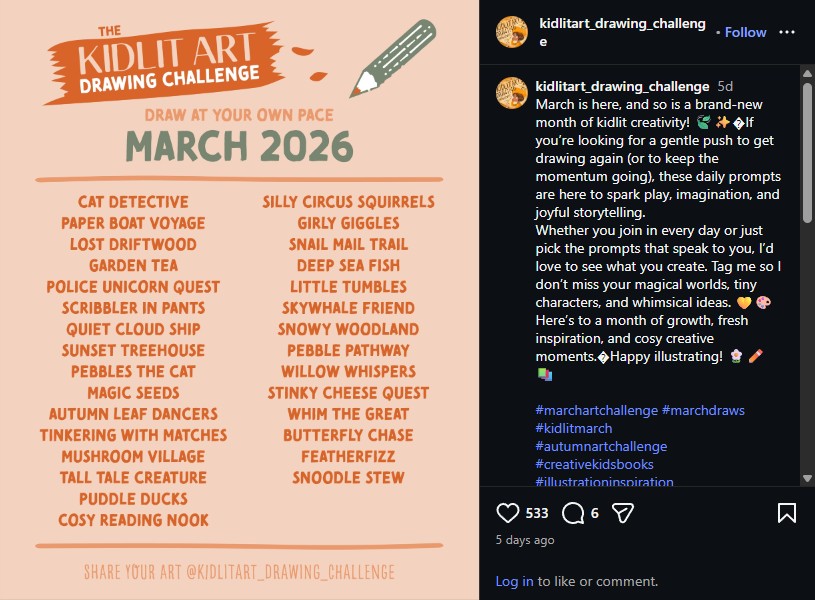
Art challenges and prompts give artists simple ideas and clear goals for making art. They help build a regular creative habit, explore new methods, practice skills, and overcome the fear of a blank page. You can follow a daily, weekly, or monthly challenge using almost any art medium.
For artists across the United States, finding time and fresh ideas for creative work can be difficult. You might draw at home, paint in a school art room, attend a public library workshop, or join a local community art group. Art challenges offer a simple way to make creative practice part of your routine, even when you have a busy schedule.
An art prompt gives you a starting idea. An art challenge adds a goal, a time limit, or a set of rules. For example, you might draw one household object each day, paint with three colors for a week, or create one small artwork every weekend. The goal is not to make every piece perfect. It is to explore ideas, learn through practice, and enjoy making art.
Source: pinterest.com
What Are Art Challenges And Prompts?
Art challenges are creative activities that ask you to make artwork within certain rules or a set period. These rules may involve a subject, technique, color limit, material, or theme. Some challenges last one day, while others continue for a week, a month, or an entire year.
Art prompts are short ideas that help you decide what to create. A prompt can be one word, such as nature, or a full task, such as painting a rainy street using only cool colors. A good prompt gives you direction but leaves enough room for your own choices.
Source: pinterest.com
Daily art challenges
Create one small piece every day. These challenges help you practice regularly and explore many subjects.
Weekly art challenges
Work with one theme for seven days. You can explore different ideas and spend more time on each piece.
Monthly art challenges
Follow a planned list of prompts for a full month. This format gives you a clear start, a steady routine, and a final goal.
Technique challenges
Focus on one art skill, such as shading, color mixing, perspective, line work, or composition.
Creative restriction challenges
Make art with limits, such as one brush, three colors, recycled paper, or a short time limit.
How Prompts And Challenges Work Together
A prompt tells you what to make. A challenge tells you how, when, or under what conditions to make it. Together, they turn a loose creative idea into a practical activity.
For example, consider the prompt draw a tree. You could turn it into a seven-day challenge by drawing the same tree from a new angle each day. You might focus on its shape, leaves, bark, shadows, branches, and seasonal changes. The subject stays the same, but each task helps you notice something new.
The prompt
Draw a tree in your neighborhood.
The challenge
Create seven different studies of that tree using different views and techniques.
Choose An Art Challenge That Fits Your Goals
The best art challenge is one that you can enjoy and complete with the time and tools you have. A difficult challenge may sound exciting, but it can become stressful if every task takes several hours. Start with a format that feels manageable.
Think about what you want to gain from the activity. You may want to improve your drawing skills, explore painting, build a sketchbook habit, or find new ideas for personal projects. Your main goal should guide the type of challenge you choose.
Source: drawingideaprompts.com
For beginners
Choose simple subjects, short drawing sessions, and familiar materials. Focus on finishing each task rather than making polished artwork.
For intermediate artists
Explore new viewpoints, harder subjects, color limits, and different forms of composition.
For advanced artists
Use complex themes, mixed media, storytelling, larger projects, and technical restrictions to test your current skills.
For busy artists
Choose short exercises that take 10 to 20 minutes. A small drawing can still provide useful practice.
For artists with creative block
Choose playful prompts that encourage unusual subjects, imagination, and freedom from perfection.
Daily Challenges
Daily challenges work well when you want a steady creative routine. You make one small piece each day and move to the next prompt. This gives you a regular reason to pick up your tools.
Keep the daily task short enough to fit your normal schedule. You can draw a cup, sketch a flower, paint a simple scene, or create a small abstract design. If a day becomes busy, use a shorter version instead of abandoning the activity.
Suggested schedule
Spend 10 to 30 minutes on one small creative task.
Weekly Challenges
Weekly challenges give you more time to study a subject. You can explore one theme through several pieces or create one finished artwork at the end of the week. This format is useful for painting, sculpture, and detailed illustration.
For example, choose flowers as your weekly theme. Study their shapes on Monday, colors on Tuesday, and light on Wednesday. Then use your notes to create a finished floral artwork by the weekend.
Suggested schedule
Complete one small study or one larger artwork each week.
Monthly And Seasonal Challenges
Monthly challenges give you a longer plan with several related tasks. You can choose a new theme for each month, such as portraits, landscapes, animals, or abstract art. Seasonal themes also provide natural ideas.
For example, spring can inspire flowers and new growth. Summer can suggest outdoor scenes and bright colors. Fall can lead to studies of leaves and warm tones, while winter can inspire indoor still life and quiet landscapes.
Suggested schedule
Choose 15 to 30 prompts and spread them across the month.
How To Create Your Own Art Prompts
You do not need a large collection of ready-made ideas to start an art challenge. You can create useful prompts by combining a subject, an action, and a creative limit. This simple method gives you endless ways to explore familiar objects and new themes.
Start with something you can observe or imagine. Then decide what you want to practice. Add one clear rule that makes the task more interesting. Finally, set a time limit that matches the size of the project.
Source: picstank.com
Choose a subject
Pick an object, person, animal, place, memory, emotion, or imaginary scene.
Choose an action
Draw, paint, sculpt, photograph, collage, redesign, or create a study of the subject.
Add a creative limit
Use a limited palette, unusual viewpoint, specific texture, or selected material.
Set a time limit
Choose a short period for a sketch or a longer period for a detailed artwork.
Use The Subject, Action, And Constraint Method
A useful prompt can be built from three parts. The subject tells you what to create, the action tells you what to do, and the constraint gives the task a clear focus.
Consider this example: paint a houseplant from below using only three colors. The subject is a houseplant, the action is painting, and the constraint is a three-color palette. You now have a clear task that explores viewpoint and color control.
Basic prompt
Draw a shoe.
Improved prompt
Draw a shoe from an unusual angle using continuous line work.
Skill-focused prompt
Draw a shoe from an unusual angle, focusing on shape, proportion, and shadow.
Build Prompts Around Specific Art Skills
If your goal is artistic growth, connect prompts to a skill you want to practice. This makes each activity more useful than choosing random subjects without a clear purpose.
You can repeat the same subject while changing the skill. For example, a simple apple can become a shape study, a shading exercise, a color study, or a lesson in composition. Repeating a subject can reveal how different techniques change the final result.
Line work
Draw a bicycle using one continuous line.
Shading
Draw a white cup and show its form with light and shadow.
Perspective
Sketch a room from a corner viewpoint.
Color
Paint a sunset using three related colors.
Composition
Create a still life with one large object and several small objects.
A Flexible 30-Day Art Challenge For Everyone
A 30-day art challenge is a useful way to explore different creative tasks without spending time choosing a new idea every day. The following plan moves from simple observation to technique, imagination, and finished work. You can use a sketchbook, canvas, digital tablet, camera, or other suitable medium.
You do not need to create a finished masterpiece each day. Some prompts are quick exercises, while others give you room to explore a subject in greater detail. If you cannot work every day, spread the activities across several weeks.
Source: pinterest.com
Week 1: Observation And Basic Skills
Practice seeing everyday objects, shapes, lines, and simple forms.
Week 2: Nature And The World Around You
Explore plants, animals, outdoor scenes, color, and texture.
Week 3: Imagination And Storytelling
Create characters, unusual places, emotions, and visual stories.
Week 4: Experiment And Improve
Try new materials, revisit old work, and create a final personal piece.
Week 1: Everyday Objects And Observation
Begin with familiar subjects. These tasks help you look closely at shape, size, and detail. Use simple materials and avoid spending too much time on small corrections.
Day 1
Draw or paint your favorite household object.
Day 2
Create the same object from a different viewpoint.
Day 3
Make a still life using three objects from your kitchen.
Day 4
Create an artwork that focuses on texture.
Day 5
Draw your hand holding an everyday object.
Day 6
Make a picture using only three colors.
Day 7
Redraw your Day 1 subject and compare the results.
Week 2: Nature And Outdoor Inspiration
Use nature as a source of shape, color, and movement. You can work from real subjects, photographs you have permission to use, or your own imagination. Focus on observation rather than perfect detail.
Day 8
Draw or paint a flower from close up.
Day 9
Create an animal using simple geometric shapes.
Day 10
Make an artwork inspired by the view outside your window.
Day 11
Show a rainy day using colors and shapes.
Day 12
Create a landscape from memory.
Day 13
Study the texture of a leaf, stone, or piece of wood.
Day 14
Make an abstract artwork inspired by a natural scene.
Week 3: Imagination And Storytelling
Now move beyond direct observation. Use unusual combinations, imaginary places, and visual stories. There are no fixed answers, so experiment with different ideas.
Day 15
Create a self-portrait without showing your face.
Day 16
Design a character inspired by a household object.
Day 17
Draw or paint a city on the back of a giant animal.
Day 18
Imagine a room where gravity works in a different way.
Day 19
Create a picture that shows happiness without using words.
Day 20
Tell a short story through three small pictures.
Day 21
Create an imaginary creature by combining two animals.
Week 4: New Techniques And Creative Growth
Use the final week to experiment and apply what you have learned. Choose materials that you already own. You can also reuse paper and other suitable materials for collage or simple sculpture.
Day 22
Create an artwork using only one color and its different shades.
Day 23
Make a collage from safe, clean pieces of reused paper.
Day 24
Build a small sculpture from suitable recycled materials.
Day 25
Create an artwork based on a word or letter.
Day 26
Combine two unrelated subjects into one scene.
Day 27
Create a poster or cover for an imaginary book.
Day 28
Finish a creative task within ten minutes.
Day 29
Revisit your favorite prompt and improve your first attempt.
Day 30
Create one finished artwork inspired by the whole challenge.
Creative Art Prompt Ideas For Different Mediums
You do not need to limit art challenges to pencil drawings. The same idea can inspire painting, digital illustration, photography, sculpture, collage, and mixed-media work. Changing the medium can also help you see a familiar subject in a new way.
Choose a prompt that matches the materials you have. You can work with basic supplies, household items, or digital tools. The main goal is to explore an idea, not to buy new equipment for every activity.
Source: hope.belarusianinstitute.org
Drawing prompts
Draw a pair of shoes from memory, sketch a crowded room, or create a face using only curved lines.
Painting prompts
Paint a sunset with a limited palette, create a rainy landscape, or show the same object under two lighting conditions.
Digital art prompts
Design an imaginary app mascot, create a fantasy landscape, or turn a simple object into a detailed character.
Photography prompts
Capture reflections, repeating patterns, unusual shadows, or everyday objects from a new viewpoint.
Collage prompts
Create a dream landscape, combine contrasting textures, or make a picture using only paper shapes.
Sculpture prompts
Build an imaginary creature, create a small abstract form, or make a simple structure from safe reusable materials.
Mixed-media prompts
Combine drawing and painting, mix paper and fabric, or use several techniques to show one theme.
Prompts For Improving Drawing Skills
Drawing challenges can help you focus on observation, proportion, line quality, and form. Instead of drawing a different subject every time, repeat a few familiar objects with new goals.
For example, draw a chair using basic shapes first. Then draw it with careful outlines, followed by a study of its shadows. This approach helps you understand the object rather than only copying its outer shape.
Shape study
Turn five household objects into simple circles, boxes, and cylinders.
Gesture drawing
Make several quick sketches of people or animals in different poses.
Perspective practice
Draw a street, room, or building from a clear viewpoint.
Value study
Create a black-and-white picture using light, middle, and dark tones.
Prompts For Painting And Color Practice
Painting prompts can help you explore color relationships, brush control, and surface texture. Start with simple objects and clear lighting before moving to complex scenes.
A useful exercise is to paint the same object with two different color plans. One version might use warm colors, while the other uses cool colors. Compare how each version changes the mood.
Warm and cool colors
Paint the same simple landscape twice, using different color groups.
Limited palette
Create a complete painting with only three chosen colors.
Brush texture
Show different surfaces using a range of brush marks.
Light and shadow
Paint a simple object under one strong light source.
Prompts For Digital And Mixed-Media Artists
Digital artists can use prompts to practice layers, shapes, lighting, and visual storytelling. Mixed-media artists can explore how different materials work together in one composition.
You do not need advanced software or expensive materials. A basic drawing app or a few suitable paper materials can provide enough options for a creative exercise.
Character design
Create an original character based on an everyday object.
Environment design
Design a small town where every building has a different shape.
Texture combination
Combine drawn patterns with paper or fabric textures.
Visual storytelling
Create three images that show a beginning, middle, and ending.
How To Stay Consistent With An Art Challenge
A good challenge should support your creative routine rather than become another source of pressure. Set a clear schedule and prepare your materials before you begin. Small steps make it easier to return to the work.
You can also make your own rules. Some artists prefer to create every day, while others work on weekends. A well-known example, Inktober, allows daily, every-other-day, or weekly participation. Its official FAQ also explains that participants can choose their own prompts and change their order. This shows that a creative challenge does not have to follow one strict schedule. 【turn745839view0】【turn745839view1】
Source: pinterest.com
Set a realistic schedule
Choose a time when you can focus without rushing. Keep your first sessions short.
Prepare your supplies
Keep your sketchbook, pencils, paints, or digital tools ready before each session.
Use a progress tracker
Mark completed tasks on a calendar or checklist. This makes your progress easy to see.
Save every artwork
Keep your work in one folder or sketchbook so you can compare it later.
Allow creative freedom
Change a prompt when needed. You can also skip a difficult task and return to it later.
Create A Comfortable Art Space
Your art space does not need to be large or expensive. A clean table, good lighting, and a few basic supplies can be enough. Keep the materials you use most often within reach.
If you work with paint, glue, cutting tools, or other materials that need care, follow their labels and use suitable ventilation and protection. Keep sharp tools and art chemicals away from children and pets. Choose safe materials that match your age and skill level.
Keep materials organized
Store tools in simple containers and clean them after use.
Protect your work area
Use a suitable surface cover when painting, cutting, or working with glue.
Use proper lighting
Choose enough light to see your subject and artwork clearly.
Make A Simple Progress Record
A progress record helps you see more than the final result. Write down the prompt, materials, time spent, and one thing you learned. These notes can show which tasks helped you most.
You can also take photographs of your artwork. Keep the images in date order and use similar lighting when comparing them. This makes it easier to notice changes in your technique and creative choices.
Record what worked
Write one short note about a technique or idea you enjoyed.
Record what was difficult
Name one problem you want to solve in a future session.
Compare selected pieces
Look at your first, middle, and final artworks to review your choices.
Sharing Art Challenges And Joining Creative Communities
Sharing your artwork can make an art challenge more social and enjoyable. You can post your work online, exchange ideas with other artists, or take part in a local creative group. Seeing different responses to the same prompt can also give you new ideas.
You do not have to share every piece. Private practice is just as valid as public participation. Choose the level of sharing that makes you comfortable and keeps your attention on the creative process.
Source: doodlewash.com
Join an online challenge
Look for established art communities, official challenge pages, and relevant creative groups.
Create with friends
Choose one prompt and ask each person to interpret it in their own style.
Organize a group challenge
Share a simple prompt calendar with a class, art club, or community workshop.
Share progress instead of perfection
Post sketches, experiments, and finished pieces when you feel comfortable.
Try Collaborative Art Challenges
Collaborative challenges allow several artists to work with the same theme. Each person can create a separate piece or add to a shared artwork. This can help groups exchange ideas and learn from different creative styles.
For example, one person can begin a drawing in a shared sketchbook. Another person can add a background, while a third person adds details. Agree on the materials, theme, and way to pass the work before starting.
Shared sketchbook
Pass one sketchbook between participants and let each person add something to the pages.
Same prompt, different styles
Ask everyone to interpret one subject using their preferred medium.
Group mural
Divide a larger design into sections and let each participant create one part.
Follow Good Creative Community Practices
Respect the work and ideas of other artists when joining a public challenge. Give credit when using another person’s reference or design, and follow the event’s participation rules. Do not present another artist’s work as your own.
If you create fan art or use a recognizable character, remember that the original work may be protected by copyright. Personal practice, public sharing, and commercial use can involve different considerations. Check the relevant permissions and platform rules before selling or using someone else’s protected work.
Respect original work
Use your own ideas and credit sources when a reference or collaboration requires it.
Keep personal details private
Check photographs for visible addresses, private documents, and other sensitive details before sharing.
Be supportive
Give useful feedback without making unfair comparisons between beginners and experienced artists.
Common Art Challenge Problems And How To Solve Them
Even a simple art challenge can become difficult when you run out of ideas, lose motivation, or have limited time. These problems do not mean you have failed. They often mean the challenge needs a small change.
Look at the cause before changing your whole plan. A task that takes too long may need a shorter version. A prompt that feels boring may need a new viewpoint or material. A demanding schedule may need more rest days.
Source: pinterest.com
Problem: You Have No New Ideas
Choose a familiar object and change its size, viewpoint, color, or setting. You can also combine two unrelated subjects to create a fresh concept.
Problem: You Keep Comparing Your Art
Compare your current work with your own earlier pieces instead of judging it against another artist’s finished portfolio.
Problem: You Do Not Have Enough Time
Reduce the task to a quick sketch or small study. A short creative session is better than waiting for a free afternoon.
Problem: You Miss A Day
Continue with the next prompt, move the missed task to another day, or take a planned break. You do not need to restart the whole challenge.
Problem: Your Artwork Looks Different From Your Idea
Treat the result as an experiment. Study what happened and try another approach instead of throwing away the work.
Problem: You Feel Bored With The Theme
Change the medium, add a creative restriction, or choose a new subject within the same theme.
What To Do When A Prompt Feels Too Difficult
Break a difficult task into smaller parts. If you need to draw a full human figure, start with simple poses and body shapes. If you need to paint a detailed landscape, begin with a few large areas of color.
You can also make an easier version of the original prompt. Keep its main idea but reduce the number of details, materials, or techniques. Once the basic version feels manageable, try adding more complexity.
Reduce the detail
Focus on the main shapes instead of every small feature.
Use familiar materials
Choose tools that you already understand before testing new ones.
Work in stages
Separate planning, basic shapes, color, and final details into smaller tasks.
How To Avoid Creative Burnout
Creative work needs room for rest and exploration. If every session feels like a deadline, the challenge may be too demanding. Reduce the pace and leave space for artwork that you create without following a prompt.
A useful challenge should support your interest in art. It should not make you feel guilty for missing a day or producing a simple sketch. Adjust the rules when your schedule or energy changes.
Plan rest days
Include breaks between longer projects or demanding sessions.
Keep some sessions playful
Use free drawing, doodling, and experiments without judging the result.
Choose quality of practice
Focus on what you learn instead of counting how many finished pieces you make.
How To Review Your Progress After An Art Challenge
The end of an art challenge is a good time to review your work. Put your completed pieces together and look for changes in your choices, technique, and confidence. Do not judge progress only by how realistic or polished the final artwork looks.
Some useful changes may be small. You might notice better control of lines, more thoughtful color choices, or greater willingness to experiment. You may also discover that some subjects and techniques interest you more than others.
Source: pinterest.com
Compare early and later work
Look at your first few pieces beside your final pieces and note specific changes.
Identify useful techniques
Write down the exercises that helped you explore a skill or solve a creative problem.
Find your favorite themes
Notice which subjects gave you the most ideas and enjoyment.
Choose your next goal
Use what you learned to plan a new challenge with a clear creative focus.
Turn Your Favorite Prompt Into A Larger Project
You may find that one small prompt gives you enough ideas for a larger artwork. For example, a simple drawing of a street might lead to a series of city scenes. A flower study might become a larger painting or a collection of botanical illustrations.
Choose one idea that interests you and develop it through sketches, reference studies, and a simple plan. This gives your next project a clear starting point without forcing you to follow the same daily format.
Choose one strong idea
Select a prompt that gave you several possible creative directions.
Explore different versions
Create small studies using new colors, viewpoints, and materials.
Plan a finished piece
Use your favorite study as the starting point for a more developed artwork.
Build Your Own Prompt Collection
Save prompts that interest you in a notebook or digital document. Group them by subject, technique, and difficulty. This gives you a personal source of ideas when you need a new challenge.
Add new ideas whenever you notice something interesting in your daily life. A building, a conversation, a shadow, or an unusual object can become the starting point for a new artwork. Over time, your collection can reflect your own interests and creative direction.
Save useful prompts
Keep the prompts that gave you interesting results or helped you practice a skill.
Record new ideas
Write down creative thoughts before you forget them.
Refresh your list
Remove ideas that no longer interest you and add new subjects when needed.
Frequently Asked Questions
Q
What Are The Best Art Challenges For Beginners?
Simple daily drawing, basic painting, and sketchbook challenges are useful starting points. Choose familiar subjects such as household objects, plants, food, and simple landscapes. Begin with short sessions and focus on learning rather than creating perfect artwork.
Q
How Long Should An Art Challenge Last?
An art challenge can last one day, one week, 30 days, or several months. Choose a length that fits your schedule and creative goal. A short challenge is useful for testing a new idea, while a longer one gives you more time to explore different techniques.
Q
Do I Need To Share My Art Online?
No. You can complete an art challenge privately in a sketchbook, folder, or personal portfolio. Sharing online is optional. If you enjoy working with others, you can share selected pieces with friends, art groups, or creative communities.
Q
Can I Use Different Art Mediums For One Challenge?
Yes. You can use pencils, colored pencils, watercolor, acrylic paint, digital tools, photography, collage, or sculpture. You can also use a different medium for each prompt. Check that the materials suit the task and follow any relevant safety instructions.
Q
What Should I Do If I Miss Several Days Of An Art Challenge?
Continue from where you stopped or change the schedule to fit your available time. You can skip missed prompts, combine a few simple tasks, or extend the challenge. Missing days does not erase the work you have already completed.
✦ Wrapping Up
Conclusion
Art challenges and prompts provide a practical way to explore creative ideas, practice new techniques, and make time for art. They can be simple daily exercises or larger projects that last several weeks. The right format depends on your interests, skill level, available materials, and personal schedule.
Start with one clear prompt and a small creative goal. Keep your work, review your progress, and change the rules when needed. Every sketch, painting, photograph, or experiment can teach you something useful, even when the final result is not what you expected.
You do not need perfect supplies, advanced skills, or a large block of free time to begin. Choose a subject that interests you, make something with the materials you have, and let the next prompt guide your next step.
💡 Key Takeaway
Start a seven-day art challenge today. Choose one simple subject, spend 15 minutes creating something each day, and save every result. At the end of the week, compare your work, identify one skill you want to improve, and use that insight to plan your next creative challenge.