Form is 3D and has depth; shape is flat and lives on a two-dimensional surface.
Form vs shape in art is one of those ideas that seems simple at first, but it quietly shapes everything from drawing and painting to sculpture and design. Once you understand the difference, you start seeing art with sharper eyes, because you can tell how artists create space, structure, and visual impact with just a few lines or planes.

What Is Shape in Art?
Shape in art refers to a flat, two-dimensional area defined by edges, color, line, or contrast. It has height and width, but no real depth. You see shape in paper cutouts, logos, silhouettes, and the outline of a leaf or a face drawn on a page.
Shape can be geometric, like circles, squares, and triangles, or organic, like the soft curve of a cloud or the uneven edge of a rock. In my own work, I often think of shape as the first visual “skeleton” of an image. Before I add value or shadow, I ask myself if the shapes read clearly from a distance.
Shape matters because it helps the viewer identify forms quickly. Strong shapes make art feel clear, balanced, and memorable. Weak shapes can make a composition feel muddy or hard to read.
What Is Form in Art?
Form in art is a three-dimensional object with height, width, and depth. It can be actual, like a sculpture, or implied, like a painted apple that looks rounded and solid. Form gives art a sense of volume and physical presence.
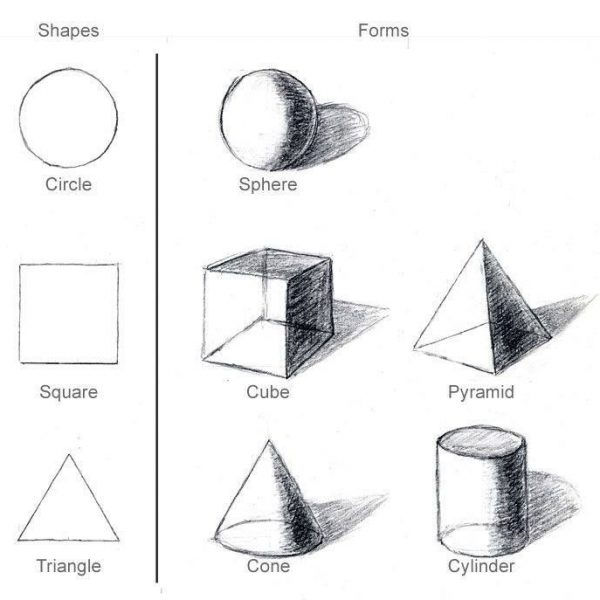
Artists create form using shading, perspective, light, shadow, and contour lines. A circle becomes a sphere when light and shadow make it look round. A square becomes a cube when depth appears on the page.
Form is one of the main tools artists use to create realism. It helps a flat surface feel alive and space feel believable. When I first learned to shade, I realized how a few soft gradients could turn a plain circle into something that felt like it could roll off the page.
Form vs Shape in Art: The Core Difference
The simplest way to remember form vs shape in art is this:
• Shape is flat.
• Form is solid.
Shape exists in two dimensions. Form exists in three. That difference sounds small, but it changes the whole feeling of an artwork.
A painted circle is a shape. Add shadow, highlight, and depth, and it becomes a form. A triangle can stay a shape on paper, or it can become a pyramid if you show its sides and volume.
This is why form vs shape in art is not just a vocabulary lesson. It affects how artists build space, guide the eye, and create emotion. Flat shapes often feel graphic and bold, while forms often feel lifelike and tangible.
Why Form vs Shape in Art Matters
Understanding form vs shape in art helps you make better creative choices. It also helps you analyze other artists’ work with more confidence. Once you know what to look for, you can tell why one image feels soft and real while another feels sharp and symbolic.
Here are a few reasons it matters:
• It improves drawing skills by helping you build objects from simple base shapes.
• It makes paintings more realistic through light, shadow, and perspective.
• It strengthens composition by balancing simple and complex visual areas.
• It helps designers create clear icons, logos, and illustrations.
• It gives sculptors and 3D artists a stronger sense of volume and mass.
I have seen many beginners rush into detail too soon. They try to draw eyelashes, fabric folds, or texture before the shape is right. The work usually improves fast when they slow down and focus on the base form first.
Shape in Art: Types and Visual Effects
Shapes come in many types, and each one creates a different mood. Knowing these types gives you more control over your art.
Geometric Shapes
Geometric shapes are precise and structured. Think of circles, squares, rectangles, triangles, and hexagons. They often feel organized, modern, and stable.
These shapes are common in architecture, graphic design, and abstract art. They are easy to recognize, which makes them useful for strong visual communication.
Organic Shapes
Organic shapes are irregular and natural. They often come from things in nature, like leaves, stones, flames, or bodies. These shapes usually feel softer, more relaxed, and more alive.
Artists use organic shapes to bring warmth and movement into a composition. They are especially useful when you want your work to feel less rigid and more human.
Positive and Negative Shapes
Positive shapes are the main objects you notice. Negative shapes are the empty spaces around and between them. Both matter, because the space around an object can be just as important as the object itself.
A smart artist watches negative shape closely. In my experience, many strong drawings improve instantly when you stop drawing only the subject and start noticing the spaces around it.
Form in Art: How Artists Build It
Form in art is created through visual cues that suggest depth. These cues help the viewer believe that an object occupies space.
Common ways to show form include:
• Shading, which moves from light to dark
• Highlight, which shows where light hits most strongly
• Cast shadow, which anchors the object in space
• Contour lines, which guide the eye around the surface
• Perspective, which shows how objects change with distance
• Overlap, which tells the viewer one object sits in front of another
A good example is a simple cube. Draw it as a flat square and it is only a shape. Add side planes, shadow, and perspective, and it becomes a form. That shift is the heart of form vs shape in art.
Form vs Shape in Art in Drawing and Painting
In drawing and painting, shape is often the starting point and form is the goal. Artists usually block in large shapes first, then build form on top of them.
A portrait, for example, begins with basic shapes for the head, jaw, eyes, nose, and mouth. Then shading and structure turn those shapes into a believable face. Without shape, the drawing can drift. Without form, it can feel flat.
Painters use color temperature and value to strengthen form. Darker tones can push parts back, while lighter areas come forward. This is how a painted object begins to feel round, heavy, or airy.
Form vs Shape in Sculpture and 3D Art
In sculpture, form is not just implied. It is real. You can walk around it, touch it, and see it from many angles.
Shape still matters in sculpture, because the outline or silhouette is often the first thing a viewer notices. But form is the main experience, since sculpture lives in actual space. The way light hits the surface changes throughout the day, and that changes how the form reads.
In 3D modeling and digital art, this same idea applies. Artists often start with simple shapes and then sculpt them into detailed forms. This process mirrors traditional art, which is a good reminder that the basic principles stay the same even as tools change.
How Light and Shadow Separate Form vs Shape in Art
Light is one of the clearest tools for understanding form vs shape in art. Shape can exist without light logic, but form depends on it.
When light falls on an object, it creates:
• Highlight
• Midtone
• Core shadow
• Reflected light
• Cast shadow
These values help the viewer read volume. A flat circle with no shadow stays a shape. Add gradual shading, and the same circle becomes a sphere.
This is why value study is so important. I have found that when students get stuck, the problem is often not line work but value control. If the lights and darks are weak, the form disappears.
Practical Examples of Form vs Shape in Art
Here are some everyday examples that make the difference easier to spot:
• A pizza slice drawn as a triangle is a shape.
• A lit wedge of pizza with thickness and shadow is a form.
• A stop sign is mostly shape.
• A painted car with reflections, curves, and depth is form.
• A leaf outline is shape.
• A leaf with curled edges and shading becomes a form.
These examples show how art moves from symbol to presence. Shape tells you what something is. Form helps you feel that it exists in space.
Common Mistakes Artists Make
Many artists confuse form vs shape in art because both are used together so often. That is normal, but a few common mistakes can hold your work back.
• Relying on outline only, which keeps objects flat
• Adding detail before structure, which weakens the design
• Ignoring shadows, which makes form hard to read
• Using too many small shapes, which can clutter the page
• Forgetting proportion, which makes forms feel unstable
One mistake I made early on was treating shading like decoration instead of structure. Once I started using shading to describe planes and volume, my drawings got much stronger.
How to Practice Form vs Shape in Art
If you want to improve, the best path is simple practice. You do not need fancy tools. You need observation and repetition.
Try these steps:
- Start with basic shapes like circles, boxes, cylinders, and cones.
- Add a light source so the shadows make sense.
- Shade slowly to turn the shapes into forms.
- Compare your drawing to real objects.
- Check whether the object feels flat or solid.
- Practice drawing the same object from different angles.
You can also study simple household items. A mug, an egg, or a table lamp teaches form very well. These objects are familiar, so it is easier to notice where the light wraps around them.
Form vs Shape in Art Across Different Styles
The balance between form and shape changes by style.
In realism, artists often emphasize form to create life-like depth. In abstract art, shape may matter more because the artist wants bold design instead of realism. In modern graphic art, shapes are often simplified for clarity and impact.
That is why form vs shape in art is not about choosing one over the other. It is about knowing which one supports your message. A poster may need sharp shapes. A portrait may need rich form. Good artists use both on purpose.
Frequently Asked Questions
What is the main difference between form and shape in art?
Shape is flat and two-dimensional, while form has depth and appears three-dimensional. A shape can become a form when light, shadow, and perspective make it look solid.
Can something be both a shape and a form?
Yes, depending on how it is shown. A circle on paper is a shape, but that same circle can become a sphere if the artist adds value and depth.
Why is form important in drawing?
Form helps drawings look solid and real. It gives objects weight, volume, and space, which makes the image easier for the viewer to believe.
Is shape more important than form in design?
Not always. Shape is often more important in logos, icons, and graphic layouts, while form is more important in realistic art and sculpture. The right choice depends on the goal of the piece.
How do artists show form on a flat surface?
Artists use shading, highlight, shadow, contour lines, and perspective. These tools help the viewer see depth even though the artwork is still flat.
Conclusion
Form vs shape in art is a small idea with a big impact. Shape gives structure and clarity, while form adds depth, realism, and presence. When you understand both, you can create stronger drawings, smarter designs, and more expressive artwork.
The best next step is to study the objects around you and notice how artists turn flat shapes into living forms. Try sketching simple items, watch where the light falls, and pay attention to the spaces around each object. If this guide helped, keep exploring art fundamentals and share your thoughts in the comments.